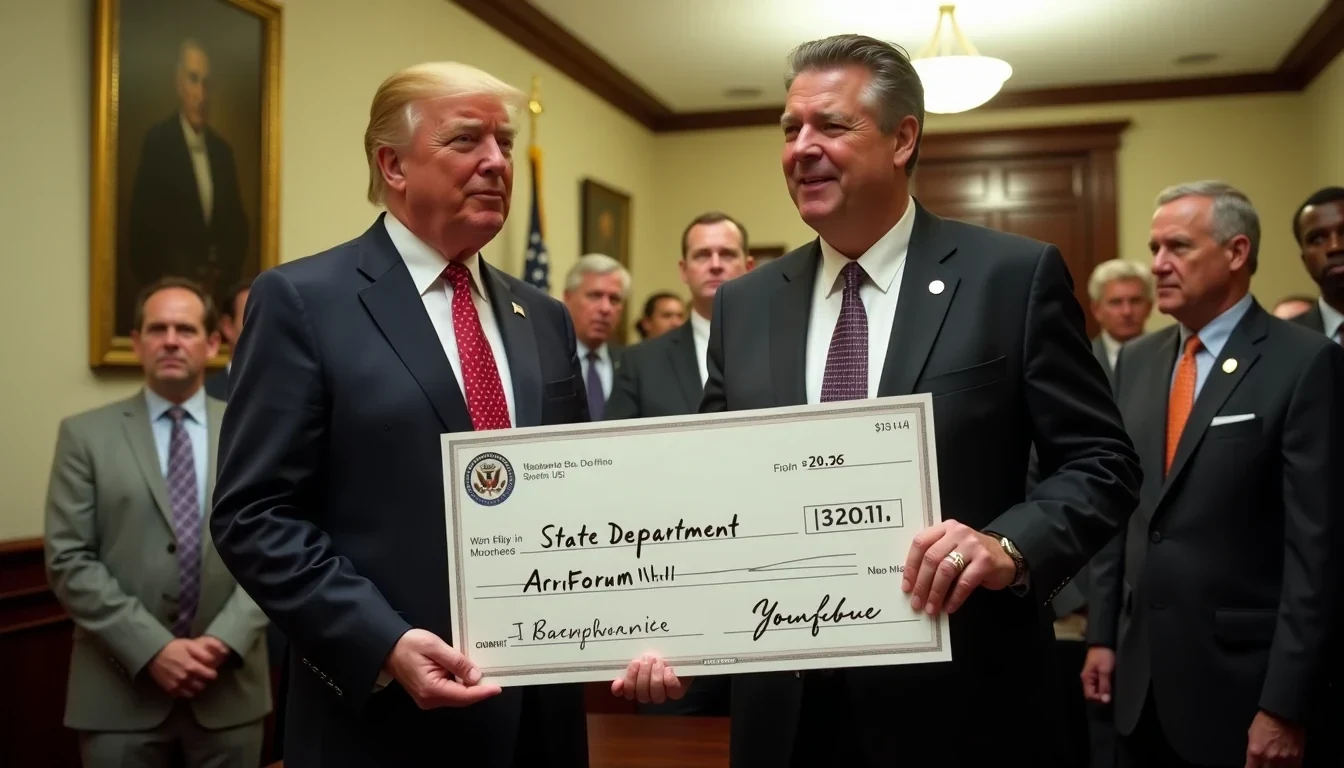
Washington has decided to give AfriForum, a lobby group known for its focus on farm murder statistics and complaints about Afrikaans universities, nearly a million dollars. This money will fund documentation of the challenges faced by minorities in South Africa. The figure is US$986,500, roughly R16.5 million, routed through the State Department’s Bureau of Democracy, Human Rights, and Labor for an 18-month project. Its title, “Documentation of Hateful Rhetoric Targeting Minority Populations in South Africa,” sounds academically neutral. However, it actually funds AfriForum’s longstanding campaign to reframe violent crime as racial persecution, now with the backing of a superpower.
The money did not arrive through open competition. It was first earmarked for Lex Libertas, an organization founded by Ernst Roets after he left AfriForum’s deputy CEO post. When US lawmakers discovered the lack of standard bidding, they pushed back, and the State Department widened the process. AfriForum then emerged as the chosen recipient anyway. The procedural detour did not change the destination. What looked like transparency was theater.
What the grant actually buys
The project brief commits AfriForum to recording violence, discrimination, and access-to-justice problems affecting Afrikaners and other minorities. This aligns precisely with the group’s existing output: press releases on farm attacks, court challenges to employment equity, and international tours presenting white South Africans as an endangered population. The difference is scale. R16.5 million buys professional research infrastructure, international credibility, and the implicit argument that Washington shares AfriForum’s analysis of power and victimhood in this country.
AfriForum says the allocation is not yet finalized. This qualifier matters legally, but politically the damage is done. The announcement itself signals US institutional support for a narrative the South African government has spent years rejecting.
The government’s position and its limits
Pretoria’s response has been predictable and not without its own problems. Officials reject any notion of systematic white genocide or racially targeted farm killings, pointing to investigations that find no organized campaign against white farmers. They are on solid ground here. Crime data does not support a racial conspiracy. Murder on farms is real and often brutal, but black farmworkers die in greater absolute numbers, and the overall pattern tracks poverty and isolation more than race.
The government’s rebuttal also reveals its own blind spots. It treats the rejection of “white genocide” as a sufficient answer to minority concerns about crime, language policy, and cultural marginalization. It is not. Many Afrikaners experience genuine anxiety about their place in a society where historical advantage has become present-day liability. The grant exploits that gap between legitimate unease and statistical reality, weaponizing it for a foreign policy purpose Pretoria would rather not name.
Washington’s angle
The Trump administration’s interest is not mysterious. This is the same Washington that has floated sanctions talk, treated land reform as theft, and found South Africa a useful stage for domestic culture-war performance. Funding AfriForum’s research offers multiple returns: it embarrasses an ANC government increasingly critical of US foreign policy, energizes a conservative base convinced white Christians face global persecution, and acquires “independent” documentation to justify whatever comes next.
The Bureau of Democracy, Human Rights, and Labor has historically funded work in genuinely repressive contexts. Redirecting those resources toward a middle-income democracy with a noisy civil society, however troubled, suggests the bureau’s criteria have bent to political convenience. The non-competitive origin of this grant, first to Roets’s vehicle and then effectively to his former employer, removes any plausible deniability about targeting.
How this lands locally
The grant will not change many minds in South Africa. Those who already believe white persecution is suppressed truth will feel validated. Those who see AfriForum as a nostalgia operation for lost privilege will find fresh evidence. The danger lies in the middle, where ordinary people are trying to manage crime, economic pressure, and racialized politics without the energy for ideological combat.
The register of debate changes. A dispute about farm murder statistics, previously a domestic argument with international far-right spectators, now arrives with State Department letterhead. The internationalization cuts both ways. AfriForum gains weight in foreign capitals. Its critics gain the language of sovereignty and anti-imperialism, which the ANC deploys with practiced ease but which also obscures real policy failures on crime and rural safety.
The deeper problem is what gets crowded out. Every hour spent arguing whether white farmers face genocide is an hour not spent on the actual drivers of violence: failed rural policing, economic desperation, the easy availability of firearms, and the collapse of trust between communities and the state. Every rand AfriForum spends documenting “hateful rhetoric” is a rand not spent on security improvements that might actually protect farm residents of any race.
The sovereignty question
South Africa’s complaint about interference is formally correct and practically complicated. Governments routinely accept foreign funding for human rights work, election monitoring, and civil society support. The objection here is not to external money per se but to its partisan destination and its premise. Washington is not funding independent research. It is funding an organization whose conclusions are largely predetermined, whose leadership has consistently advocated a specific political line, and whose international profile serves US conservative interests more than South African reconciliation.
The asymmetry rankles. A superpower with its own unresolved racial violence, police killings, and democratic backsliding presumes to diagnose and document South Africa’s condition through the lens of a single advocacy group. The presumption would be offensive even if the diagnosis were accurate. Given the actual crime data, it is worse than offensive. It is destabilizing.
What comes next
AfriForum’s research, if completed, will produce reports, press conferences, and congressional testimony. The findings will be contested, the methodology scrutinized, and the conclusions predictable. What will linger is the precedent: that US human rights funding can be directed, through channels that bypass normal competition, toward groups that align with the administration’s ideological preferences. South Africa is the current case. It will not be the last.
For ordinary South Africans, the grant adds another layer of performance to politics already saturated with it. The farm attack debate, never fully grounded in evidence, now carries the weight of superpower sponsorship. The government’s rebuttal, partially justified, will be used to deflect from its own failures. Everyone with a fixed position gets stronger. Everyone trying to think clearly about crime and race gets drowned out.
The R16.5 million buys many things. Clarity is not among them.