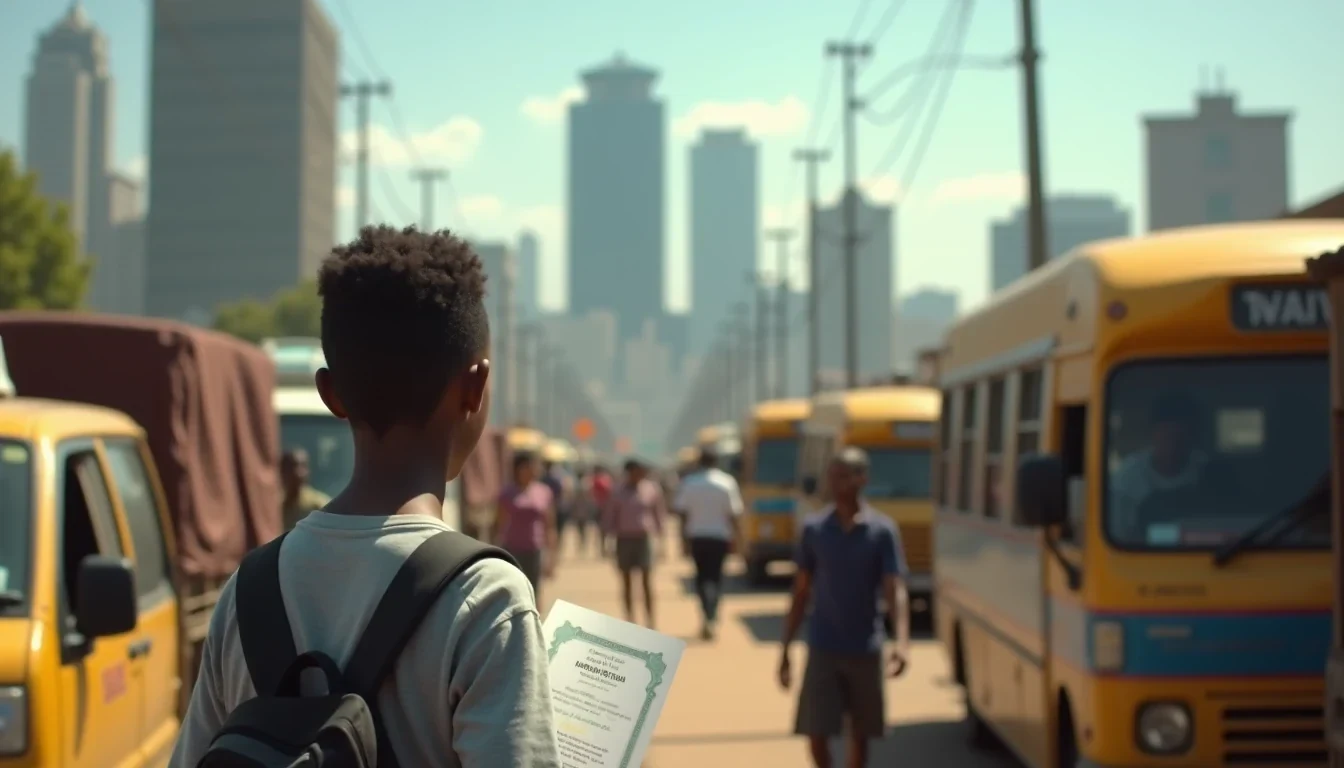
A factory floor used to be the nearest thing South Africa had to a ladder. You could come off a farm, a township street, or a rural village, learn a trade, get into an assembly line or a mine or a plant, and start building a life that looked nothing like the one you were born into. That ladder has been kicked away while the country keeps pretending the next rung is waiting somewhere in finance, consulting, code, and other jobs that require the sort of schooling the system still does not deliver.
Now we have a strange, ugly arrangement. The economy speaks the language of spreadsheets and advanced skills, while the schooling system keeps sending out young people who cannot reliably clear the basic academic bar that would get them onto that path. The result is a national trap with a very neat explanation and no serious escape plan.
The old bridge is gone
For decades, industrial work was the practical route out of poverty in richer countries and in the fast-rising economies people like to admire from afar. Manufacturing absorbed rural labour, pulled families into towns, and gave people enough income and stability to move into the middle class. It was predictable, not glamorous. That mattered more.
Here, that route narrowed before most people had crossed it. Manufacturing has shrunk hard. Mining no longer dominates. Agriculture remains too small and too weak to carry large numbers of workers into formal livelihoods. In their place sits a services-heavy economy, with finance, real estate, and business services now at the top of the pile.
The numbers tell the story plainly. In 1994, manufacturing still made up 20.9% of GDP. By 2023, that share had fallen to about 11.5%. Finance, real estate, and business services moved the other way, rising to roughly 22.5% and becoming the biggest sector. Mining slipped to around 7.5%. Agriculture stayed stuck below 3%. This country tore out the industrial staircase and asked people to jump.
Urbanisation without the jobs
That kind of shift might be survivable if industrial jobs were still there in sufficient numbers for new urban arrivals. They are not. Manufacturing employment fell by more than 200,000 jobs between 2008 and 2023. The townships and peri-urban settlements that absorbed people moving in search of work did not get factory gates, training pipelines, and steady wages. They got taxi ranks, backroom rentals, informal trading, and endless competition for scraps.
The South African version becomes harsher than the neat stories told about East Asia or post-war Europe. There, manufacturing served as a bridge from the countryside to the city and from the city to the middle class. Here, the bridge collapsed before the crowd had crossed. Poor and rural families were left to move into an economy that no longer had room for the kind of work that once lifted people steadily upward.
The economy asks for skills it never helped build
The country now rewards advanced skills, but only for a narrow slice of the population. Tertiary education lowers the unemployment rate to about half the national average. For everyone else, whether they have matric or not, the picture is stubbornly bleak. Unemployment sits near or above 30%. A matric certificate by itself no longer opens much; it just marks the point where the system stopped helping.
The schools make that brutal fact even harder to ignore. Of the 1.23 million learners who started Grade 1 in 2014, only about 65,000 are expected to pass Maths with 50% or more by matric in 2025. That is roughly 5% of the original cohort. Five percent. A country cannot run a finance-heavy, services-led economy on a pipeline that thin and then act surprised when the labour market looks split in two.
The official pass-rate talk hides the damage. A headline matric pass rate can sound respectable while the real output remains weak in the subjects that matter for engineering, finance, data, medicine, and technical work. In 2023, only 272,370 candidates wrote pure Mathematics, while 355,001 chose Mathematical Literacy. That choice is not a moral failing. It is the fingerprint of a system that pushes large numbers of pupils away from the subjects that would actually make them employable in the economy the country says it wants.
A policy gap disguised as noise
What makes the whole thing more insulting is how little serious policy imagination seems to exist around it. Government talks about education, industrialisation, youth unemployment, and transformation. Then it lets industrial investment wobble, lets basic schooling keep failing in the same places, and behaves as though these are separate issues.
They are the same issue.
A high-skill economy with a low-skill workforce does not produce broad prosperity. It produces a neat professional class, a desperate majority, and a political class that keeps promising inclusion without building the material path that makes inclusion real. The result is visible in every part of life. In middle-class suburbs, parents spend R50,000 to R300,000 a year on private schools because they know the state system is not enough. In townships, young people with matric queue for jobs that never come and drift into the informal economy. In rural areas, the schools are thinner, the infrastructure weaker, and the exits fewer. People move to the city anyway, because staying put offers even less.
The country failed to educate its workforce for the new economy and allowed the old economy to wither before the new one could absorb the people left behind. That is the real scandal. South Africa built a bridge to the middle class, then dismantled it while most people were still standing on the wrong side.